Research note · 2027 budgeting · Germany
How much will German road freight cost in 2027?
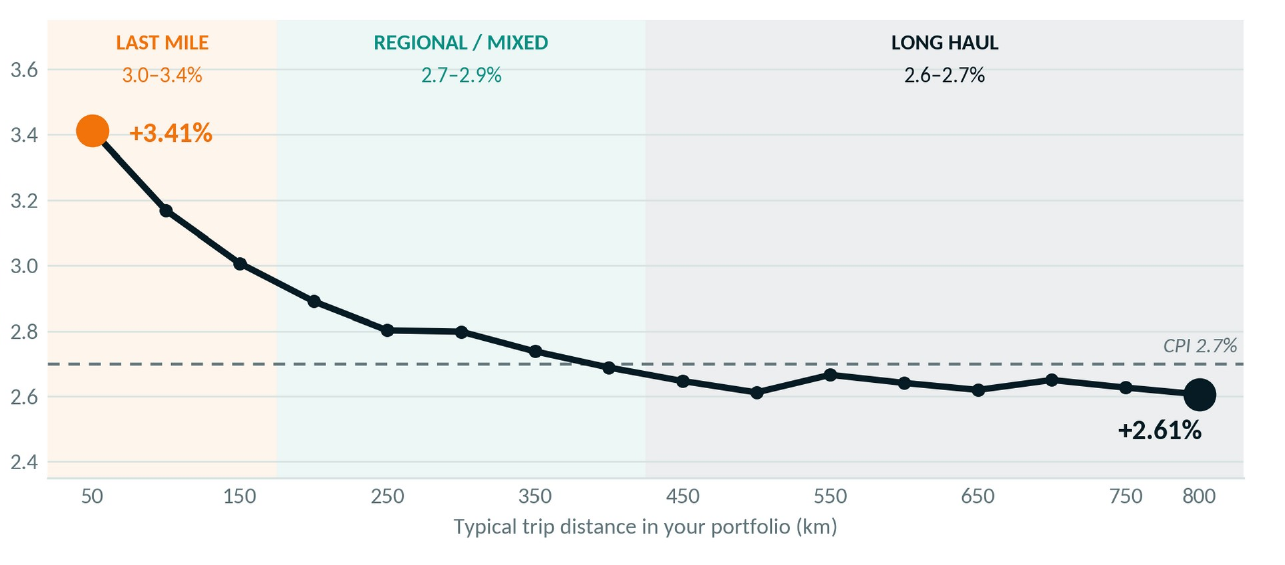
There is no single 2027 increase for German road freight. The right assumption depends on how your trucks run: from +3.4% for last-mile delivery to +2.6% for long haul, against a CPI consensus of 2.7%.
The short answer
Most shippers roll their freight budget forward with CPI — 2.7% for Germany in 2027 on the Bundesbank, European Commission and IfW Kiel consensus. That works only if your network happens to look like the average. Know your portfolio, and let it drive the assumption.
| Portfolio profile | 2027 assumption | Typical distance | What it means |
|---|---|---|---|
| Last mile & urban | 3.4% | mostly under 150 km range 3.0–3.4% | Driver time is over half the trip cost, so the 2027 wage step lands almost in full. Budget above CPI. |
| Mixed / regional | ≈2.7% | short and long runs range 2.7–2.9% | Short and long runs offset each other and the total lands near CPI. Right on average, not lane by lane. |
| Long haul | ≈2.6% | mostly 450 km+ range 2.6–2.7% | Fuel and tolls dominate and diesel is indexed separately. A CPI uplift over-allows the carrier. |
Why does driver time, not kilometres, set the increase?
Every trip carries about three hours of loading and unloading, whatever the distance. On a 50 km delivery that fixed time makes labour more than half the cost; on an 800 km run the kilometres dominate and fuel and tolls take almost half. With Germany's minimum wage rising about 5% to €14.60/h in January 2027, the labour share decides the result.
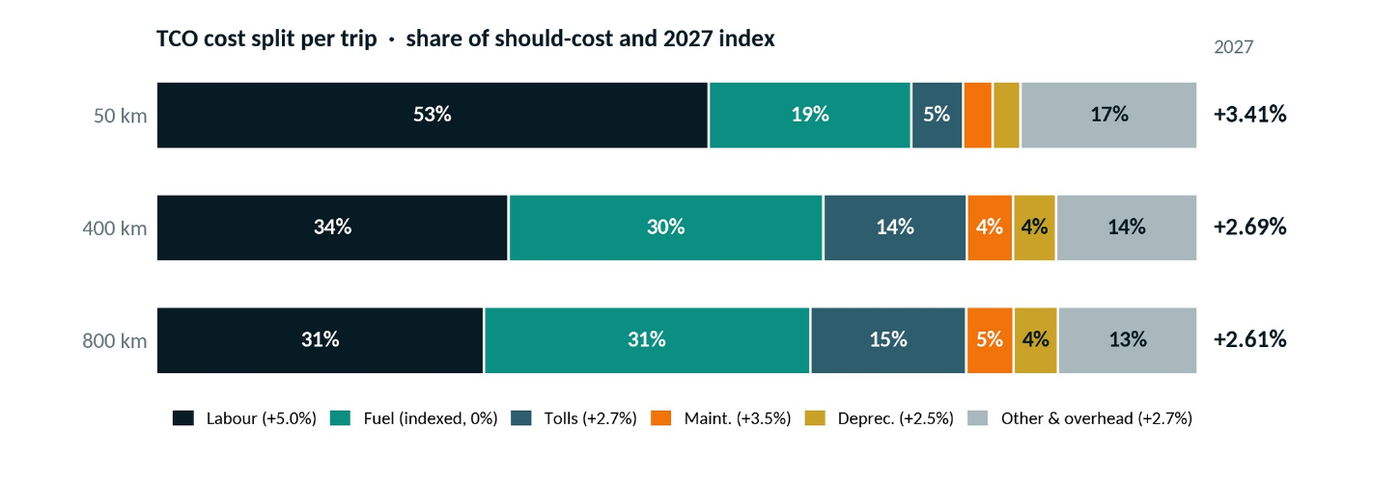
| Cost element | 2027 change | 50 km share | 50 km pts | 800 km share | 800 km pts |
|---|---|---|---|---|---|
| Labour | +5.0% | 53% | +2.65 | 31% | +1.57 |
| Fuel | 0% (indexed) | 19% | +0.00 | 31% | +0.00 |
| Tolls | +2.7% | 5% | +0.13 | 15% | +0.40 |
| Maintenance | +3.5% | 3% | +0.10 | 5% | +0.16 |
| Depreciation | +2.5% | 3% | +0.07 | 4% | +0.11 |
| Other & overhead | +2.7% | 17% | +0.46 | 13% | +0.36 |
| 2027 increase | — | 100% | +3.41% | 100% | +2.61% |
Diesel is held at 0% because most contracts pass it through monthly. If diesel rises 10%, a last-mile run gains only 1.9 points, a long-haul run 3.1. Last-mile shippers should budget for wage pressure; long-haul shippers for diesel exposure. Run diesel through the fuel clause, never as a second allowance in the rate.
What does a flat CPI budget actually cost?
| Customer profile | Typical trips | Assumption | 2027 increase | vs flat CPI 2.7% |
|---|---|---|---|---|
| Urban / last-mile distributor | ≈50 km | 3.4% | +€341k | €71k more than CPI |
| Regional short-haul shipper | avg 252 km, 87% under 400 km | 2.8% | +€283k | €13k more than CPI |
| Mixed national shipper | avg 410 km | 2.7% | +€270k | ≈ same as CPI |
| Long-haul shipper | ≈800 km | 2.6% | +€261k | €9k less than CPI |
A last-mile distributor who budgets CPI starts the year €71k short per €10m. A long-haul shipper who accepts CPI from carriers pays for inflation the lanes do not carry. The mixed shipper is fine in total but still needs lane-level allowances for the tender.
What does a German Mega trailer cost per trip by distance?
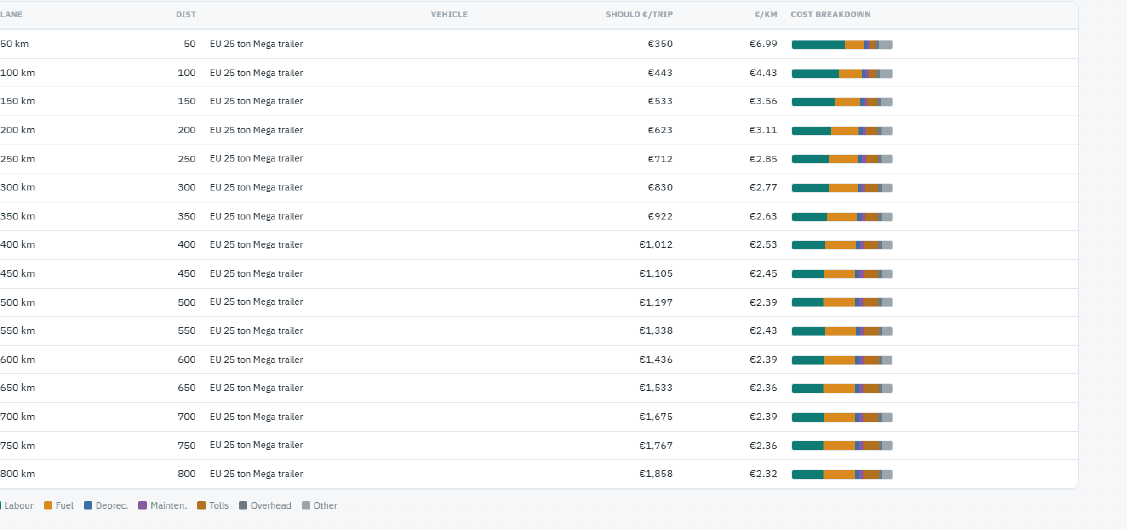
| Distance | Should-cost / trip | € / km |
|---|---|---|
| 50 km | €350 | €6.99 |
| 100 km | €443 | €4.43 |
| 150 km | €533 | €3.56 |
| 200 km | €623 | €3.11 |
| 250 km | €712 | €2.85 |
| 300 km | €830 | €2.77 |
| 350 km | €922 | €2.63 |
| 400 km | €1,012 | €2.53 |
| 450 km | €1,105 | €2.45 |
| 500 km | €1,197 | €2.39 |
| 550 km | €1,338 | €2.43 |
| 600 km | €1,436 | €2.39 |
| 650 km | €1,533 | €2.36 |
| 700 km | €1,675 | €2.39 |
| 750 km | €1,767 | €2.36 |
| 800 km | €1,858 | €2.32 |
How to build the assumption for your own portfolio
- Load your portfolio. Lanes, vehicle types and last year's truck counts, straight from your TMS export.
- Price every lane or distance band with a full TCO cost split, then apply the 2027 index per cost element: wages, tolls, maintenance, depreciation, inflation.
- Take your own 2027 assumption, plus band-level allowances for the tender, with diesel kept separate and every number traceable to a public index.
Inputs, assumptions and sources
Operating inputs: German domestic, EU 25 t Mega trailer, German driver; 2 h load, 1 h unload, two stops, 50 km backhaul at every distance; tolls estimated at €0.348/km; default overhead and margin.
2027 changes applied: labour +5.0% (scenario based on the statutory minimum wage €13.90 → €14.60/h — confirm actual carrier pay before tender), tolls +2.7%, maintenance +3.5%, depreciation +2.5%, other and overhead +2.7%, diesel 0% (indexed).
Sources: Frintelis portfolio export (21 September 2026); Bundesbank Forecast for Germany (June 2026); European Commission Spring 2026 Forecast; IfW Kiel and ifo autumn forecasts (September 2026, ifo 3.0%); German Federal Government minimum wage schedule; Toll Collect tariffs.
Get the 2027 assumption for your portfolio
Two ways to use it, depending on whether you want the tool or the work done.
1 — Frintelis, the platform
Send your lane list and see your tailored 2027 budget assumption, with band-level allowances for the tender. Currently in an invitation-only pilot.
2 — Advisory: tender and cost-model support
Independent support for European road freight procurement, delivered by the person who built the engine behind these notes.
Gyorgy Sike — twenty years in logistics network design and transport category management across European manufacturing. Currently responsible for transport strategy and cost transparency across a 30+ site European production network. Previously Global Logistics Category Manager at Norsk Hydro's extrusion business, running tender programmes delivering 13–21% cost reduction across five European markets — and where the first road freight TCO models behind Frintelis were built. Earlier network design and lowest-landed-cost modelling at iQor and Jabil, covering forward and reverse flows across Europe and the Americas. MSc Economics (international trade and the EU), University of Miskolc.
- RFQ and tender support — should-cost positions for your lane set before quotes come in, and a structured read of the field once they do.
- Cost model build — a bespoke should-cost or cost-to-serve model for your network, equipment mix and labour bases, handed over so your team owns it.
- Budget and rate forecasting — cost-driver-based planning figures for the coming budget year rather than last year's rate plus an index.
- Quote review and negotiation preparation — element-by-element reconciliation of carrier offers, and the questions that hold up in the room.
- Carrier portfolio and tendering frameworks — governance, evaluation structure and benchmarking for fragmented multi-site networks.
Scope. Road freight, Europe. Full truckload and groupage, multi-site manufacturing and distribution networks. Not ocean, air or parcel.
Independent. Not a 4PL, not a broker, no carrier commissions and no revenue share on savings. The only thing being sold is the analysis.
Engagements are scoped to a single tender cycle or a defined lane set, remote across Europe. Working languages: English and Hungarian, German at working level. Get in touch and we can work out whether it fits.